Trade with a plan.
Prove it with data.
Learn one simple Supply & Demand strategy, practice it until it’s automatic, and journal every trade so you can see exactly whether you followed your own rules, or didn’t.
Good morning, Trader.
Live overviewLook at the week, not one trade
One losing trade says little. Your weekly and monthly result tells the real story.
Trading with the trend
Revenge trading
Your journal should do more than record trades.
Connect learning, practice, journaling and analysis into one continuous feedback loop. It shows what you do well, where your process breaks down, and what to improve next, so every trade becomes part of getting better.
Learn it
Understand the fundamentals, then the Supply & Demand strategy itself.
Practice it
Apply it on real chart examples until it feels automatic, not theoretical.
Journal it
Log every trade manually: the details, your rules, your state of mind.
Analyse it
See your edge, your leaks, and how closely you stuck to your plan.
Improve it
Turn your insights into action. Refine your strategy, fix your leaks, and keep improving.
One strategy. Four clear rules.
You don’t need twenty strategies. You need one you understand completely and can execute consistently.
Start with the fundamentals. Even experienced traders often have gaps in the basics. Then master the strategy and apply both to real market examples until execution becomes second nature.
As you trade, the system tracks your progress and points you back to the right lesson when your own data reveals a recurring weakness.
Find the trend
Establish direction before you look for anything else.
Identify a break of structure
Confirm continuation in the direction of that trend.
Wait for price to return
Let price come back to the zone before you act.
Choose your entry
Aggressive or conservative, decided in advance, not in the moment.
Put what you learn into practice.
Learning a concept is only the start. Practice trains you to recognize it on a real chart.
Work through interactive exercises based on the basics and the strategy you’re learning. Apply your knowledge directly on the chart and learn to recognize what you’ve been taught.
Get instant feedback on every exercise, learn from your mistakes, and repeat until reading the chart starts to feel natural.
Your rules. Your system.
Build your own trading checklist, then log every trade against it. Capture what you did, why you did it, how you felt, and whether you followed your plan.
Every trade is logged by you, on purpose. That keeps you involved in the review instead of just collecting data. Over time, your journal becomes a clear record of your decisions, discipline, and progress.
A built-in calendar shows when you traded and how you’re tracking toward your monthly goal.
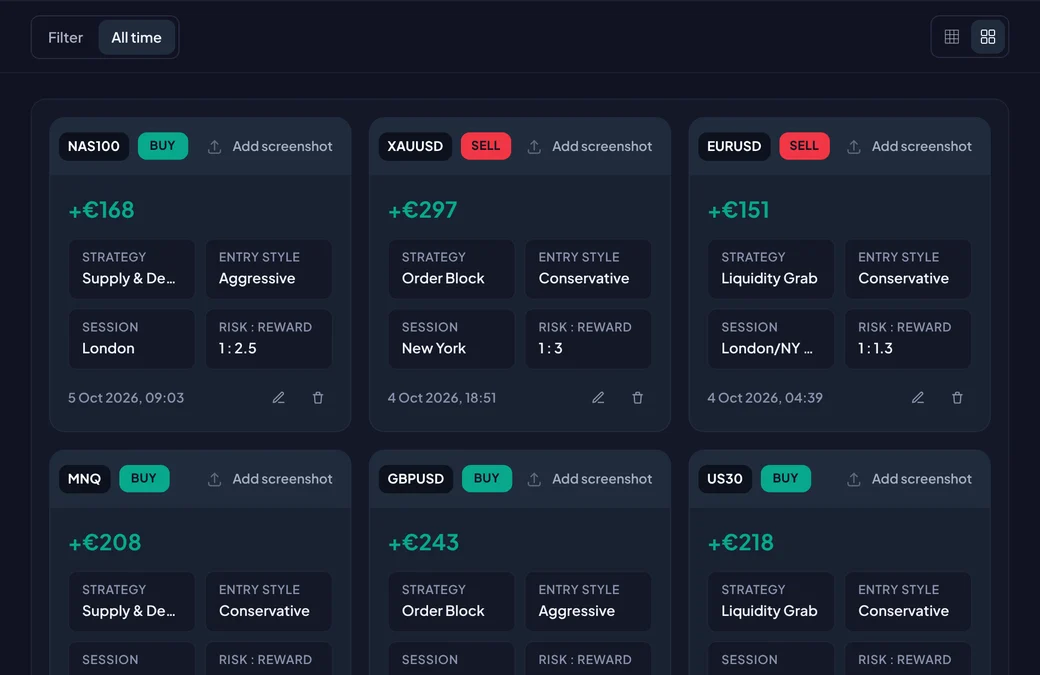
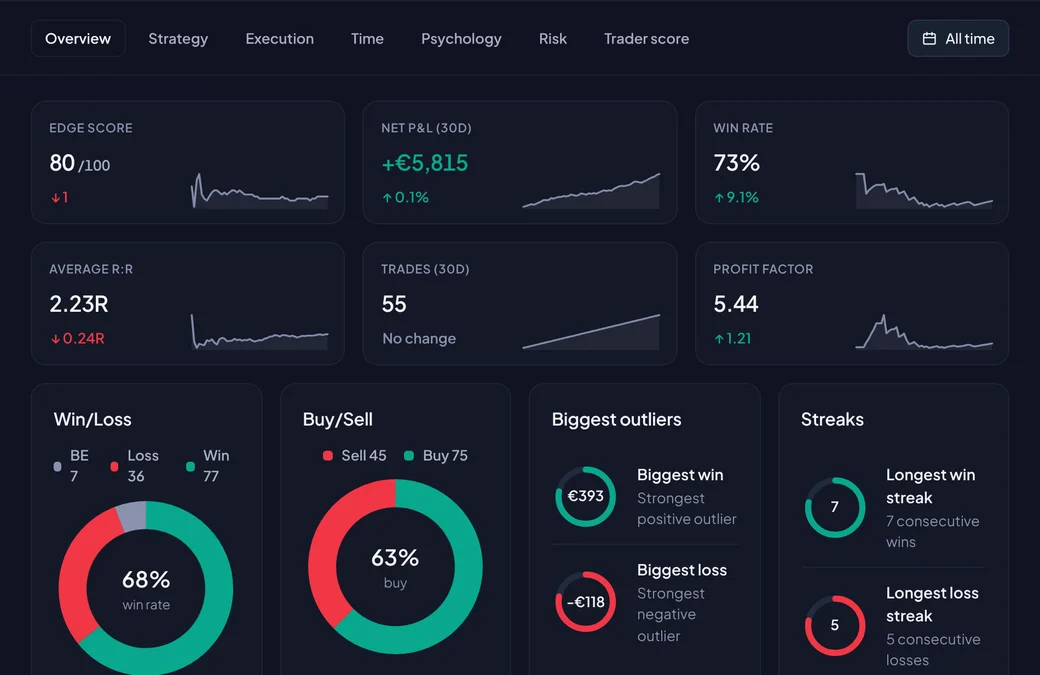
See your edge, not just your P&L.
Every trade you journal feeds your analysis: win rate, R:R, discipline score, and how closely you stuck to your own rules.
Spot your strongest setups, your biggest leaks, and the behaviors that keep repeating, broken down by session, pair, and mindset, so you know exactly what to work on next.
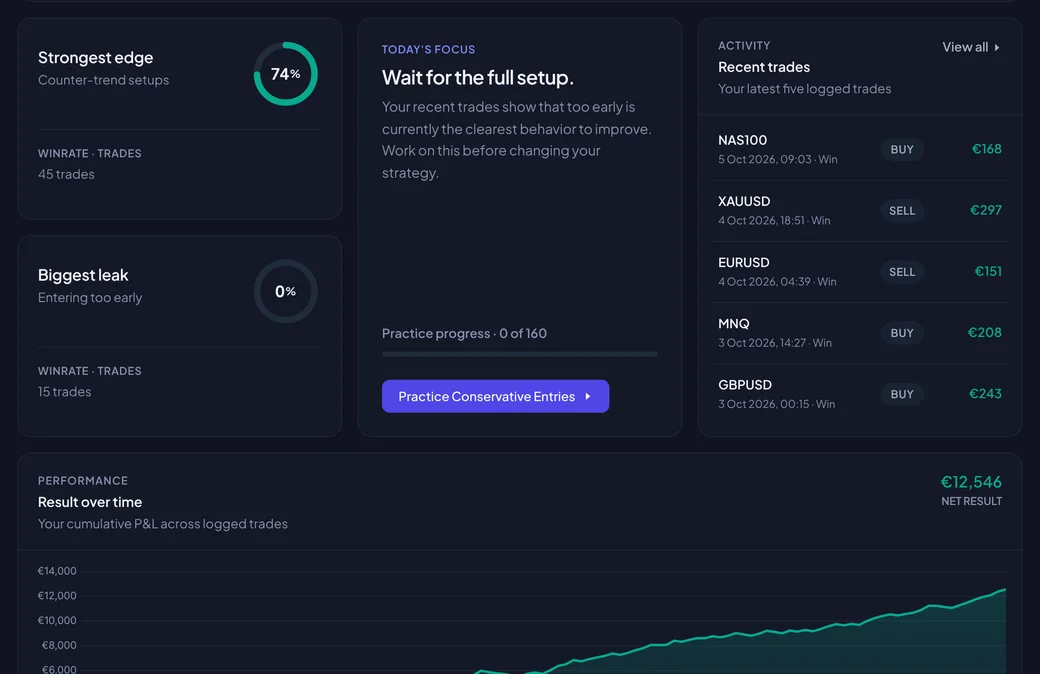
Turn your data into better decisions.
Analysis only matters if it changes what you do next.
Edge Journal turns patterns in your trading into clear things to work on. See which rules you break, which mistakes keep happening, and where you perform best. Use these insights to improve your process, instead of guessing what to fix.
When you find a weakness, go back to the lesson or practice that helps with it. Fix the problem, test the change, and keep building a process you can rely on.
A trade can follow every rule and still lose. That doesn’t make it a bad trade.
Most platforms track profit. We track discipline.
Execution quality and outcome are two completely different things. Judge your trading on process, not on profit or a loss.
The week matters more than the trade
One losing trade says very little. Your result over a week or a month, measured against your own rules, tells the real story.
You improve by executing, not by hunting
You don’t get better by constantly learning new strategies. You get better by consistently executing the one you already know.
Everything you need
in one platform.
- Full basics + Supply & Demand strategy course
- Interactive practice on chart examples
- Manual trading journal with your own custom rules
- Trading calendar with monthly goal tracking
- Full behavioral & performance analysis
- Self-funded or prop firm
- PDF report exports
The all-in-one workspace
Explore the full range of features designed to build discipline, track execution, and refine your edge.
FAQ
Is this suitable for complete beginners?
Yes. Edge Journal starts with the fundamentals before introducing the strategy, so you won’t be missing any basics along the way.
What if I already know the trading basics?
You can move through the fundamentals quickly and spend most of your time on the Supply & Demand strategy, practice, and journaling.
What strategy will I learn?
A single, clearly defined Supply & Demand strategy with four rules: find the trend, identify a break of structure, wait for price to return, and choose your entry.
Which markets can I trade with this strategy?
The strategy applies to any liquid market with clear price structure, including indices, forex, crypto and futures.
Can I use my own trading rules?
Yes. Your checklist and journal are fully customizable so the platform reflects your own process, not a generic template.
Why are trades entered manually?
Typing each trade in forces you to actually look at it: what you did, why, how you felt, and whether you followed your plan.
Can I use multiple trading accounts?
Yes, you can log and track trades across several self-funded or prop firm accounts.
What does the analysis show?
Where your execution is strong, where it breaks down, and which behaviors keep repeating across your trading history.
Does the platform provide trading signals?
No. Edge Journal is educational and analytical software, not a signals service.
Does this guarantee profitable trading?
No. Nothing can guarantee profits. Edge Journal helps you build and evaluate a consistent process instead.
Can I generate reports?
Yes, you can export PDF reports summarizing your performance and behavioral analysis.
Educational purposes only. Nothing on this platform constitutes financial or investment advice. Trading involves risk, and you may lose some or all of your invested capital. Past performance does not guarantee future results. You remain responsible for your own trading decisions.